
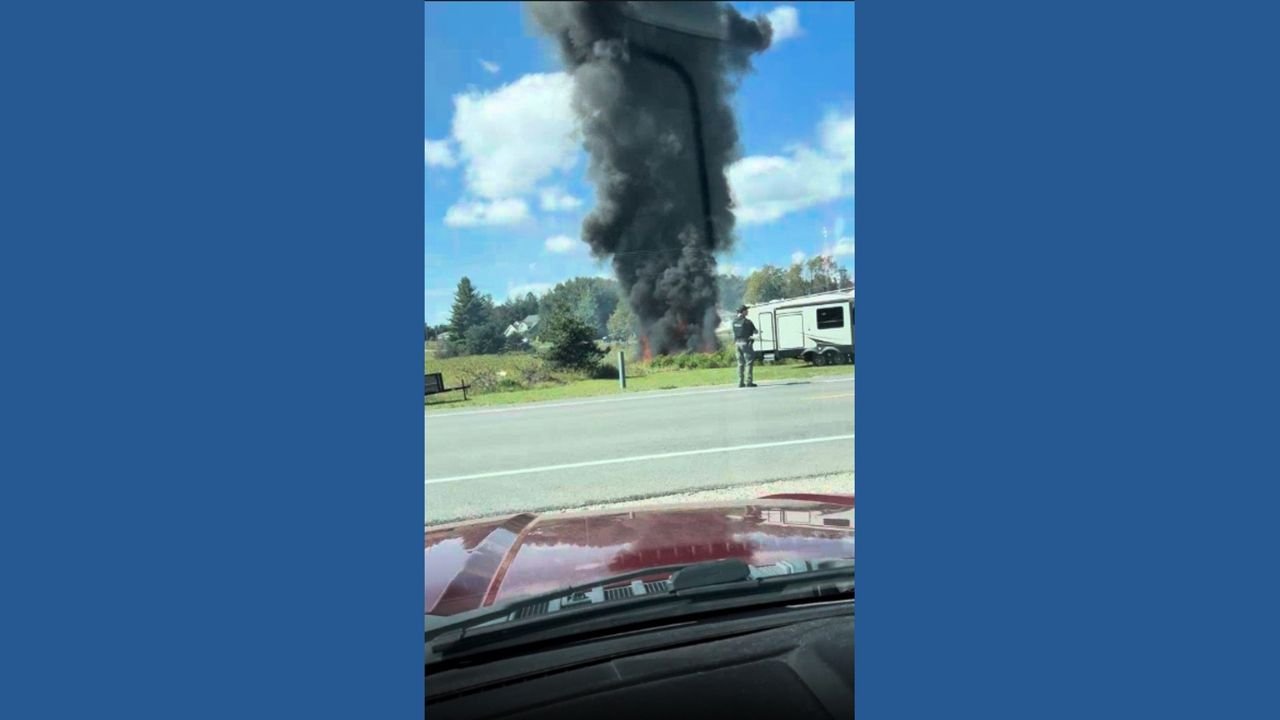
A Texas Air National Guard F-16 fighter jet crashed in northern Michigan on Thursday afternoon during a routine training mission, prompting an emergency response and the evacuation of people living within one mile of the crash site.
The pilot safely ejected from the aircraft and was taken to a local hospital, where officials said the pilot was in stable condition. Authorities said no other injuries had been reported in connection with the crash.
Quick Guide
- Aircraft: F-16 Fighting Falcon
- Military unit: 149th Fighter Wing, Texas Air National Guard
- Location: Green Lake Township, Grand Traverse County, Michigan
- Crash area: Near County Road 633 and Blair Townhall Road
- Time: Shortly before 2 p.m. Thursday, Sept. 17, 2026
- Mission: Routine training exercise
- Training operation: Operation Northern Cactus
- Pilot: Safely ejected and reported in stable condition
- Civilian injuries: No other injuries reported
- Evacuation: Residents within approximately one mile of the crash site were ordered to evacuate
- Cause: Under investigation
Where Did the F-16 Crash in Michigan?
The crash occurred shortly before 2 p.m. Sept. 17 near County Road 633 and Blair Townhall Road in Green Lake Township, in the Grand Traverse County area near Traverse City.
Emergency crews quickly responded to the scene, and traffic was restricted around the crash site. Grand Traverse County officials initially issued emergency instructions for people in the surrounding area before expanding the response to an evacuation zone covering properties within about one mile of the wreckage.
Michigan State Police said the evacuation was prompted in part by a hazardous chemical spill associated with the aircraft crash.
Residents were told to stay away from the area and follow directions from emergency personnel.
F-16 Was Part of Texas Air National Guard Training
The aircraft belonged to the 149th Fighter Wing of the Texas Air National Guard, based at Joint Base San Antonio-Lackland in Texas.
The unit had brought student and instructor pilots to Michigan to participate in Operation Northern Cactus, a training exercise based at the Alpena Combat Readiness Training Center.
The exercise was designed to provide training in operating away from the unit’s home station. The 149th Fighter Wing confirmed that the aircraft involved was conducting a routine training mission when the incident occurred.
Pilot Safely Ejected Before Crash
Sgt. Derek Gutierrez, a public affairs specialist with the 149th Fighter Wing, said the pilot ejected safely and was receiving medical treatment at a local hospital.
Military officials did not initially release the pilot’s identity or specific information about any injuries.
A spokesperson for the 149th Fighter Wing later confirmed that the pilot was in stable condition. Michigan State Police also reported that there were no other known injuries related to the crash.
Witnesses Describe Loud Crash and Heavy Smoke
People living near the crash site reported hearing a loud noise before seeing smoke rising from the area.
Wendy Sobeck, who lives nearby with her husband, told the Associated Press that they initially thought the sound was a vehicle accident.
She said they then saw a large plume of black smoke. Her husband drove toward the area and saw aircraft debris scattered across a field.
Sobeck also reported hearing additional explosions after the initial crash.
Images and video from the area showed a large column of dark smoke rising above the crash site.
What Caused the Michigan F-16 Crash?
The official cause of the crash has not been determined.
The incident remains under investigation by military and local authorities.
Some reports have cited air traffic control audio in which another pilot appeared to indicate that the aircraft may have experienced a bird strike. However, that possibility has not been officially established as the cause of the crash and should not be treated as a confirmed finding.
Authorities are continuing to assess the crash site and aircraft wreckage as part of the investigation.